Ruckhouse Guide No. 1
Getting Started with Obstacle Course Racing
New to OCR, or eyeing your first Spartan? Everything you need to go from “that looks insane” to crossing your first finish line.
Obstacle course racing is running plus obstacles: walls to climb, things to carry, mud to crawl through, and rigs to hang from, over a few miles of terrain. You do not need to be an elite athlete to start. You need a first race that fits you, a handful of skills, a few weeks of smart work, and a game plan. This guide gives you all four.
The six skills a race actually asks of you
Almost every obstacle is a version of one of these six things. Train them and the course stops being a mystery.
A weak grip is the single most common reason people fail an obstacle and take the penalty. It is also one of the most trainable things on this list. Start there.
Pick your first race
Spartan is the big one, built in three tiers (Sprint, Super, Beast) that stack into a Trifecta. Tough Mudder is team-based, untimed, and a blast, the usual gateway. Savage Race is fast and grip-heavy. Bonefrog is Navy SEAL-inspired, and there is one near Buffalo. If mud is not your thing, DEKA and HYROX are the indoor, no-mud cousins.
| Race | Distance | Feel | First race? |
|---|---|---|---|
| Spartan Sprint | ~5 km, ~20 obstacles | The classic starter | Yes |
| Tough Mudder | ~8 km, team, untimed | Fun over fast | Yes |
| Spartan Super | ~10 km | A real step up | After one |
| Spartan Beast | ~21 km | A season-long goal | Later |
| DEKA / HYROX | Indoor, no mud | Benchmark racing | Anytime |
Start with a Sprint or a Tough Mudder. Finish one, catch the bug, chase the next.
A simple 8-week on-ramp
Three focused days a week gets a healthy beginner ready. Build a base, add obstacle skills, hit one hard week, then taper into race day. Here is the shape of it.
Five beginner mistakes
- Only training the running. The obstacles are the hard part.
- Going out too fast and blowing up before the first big obstacle.
- Skipping grip work, then failing the rig with the finish line in sight.
- Racing alone your first time. Grab a friend and split the misery.
- Fearing the penalty. Everybody misses one. Take your loop and keep moving.
Getting-started questions
Do I have to run the whole thing?
No. Almost everyone walks the hills and the technical sections. Run the flats, walk the climbs, and keep moving. Finishing is the goal.
How fit do I need to be to start?
If you can jog a couple of miles and you are willing to train grip and carries for a month, you can finish a Spartan Sprint or a Tough Mudder.
What should I wear?
Trail shoes with real grip, snug moisture-wicking clothes, and gloves only if you have trained in them. Leave the cotton at home.
Where can I train for OCR in Rochester?
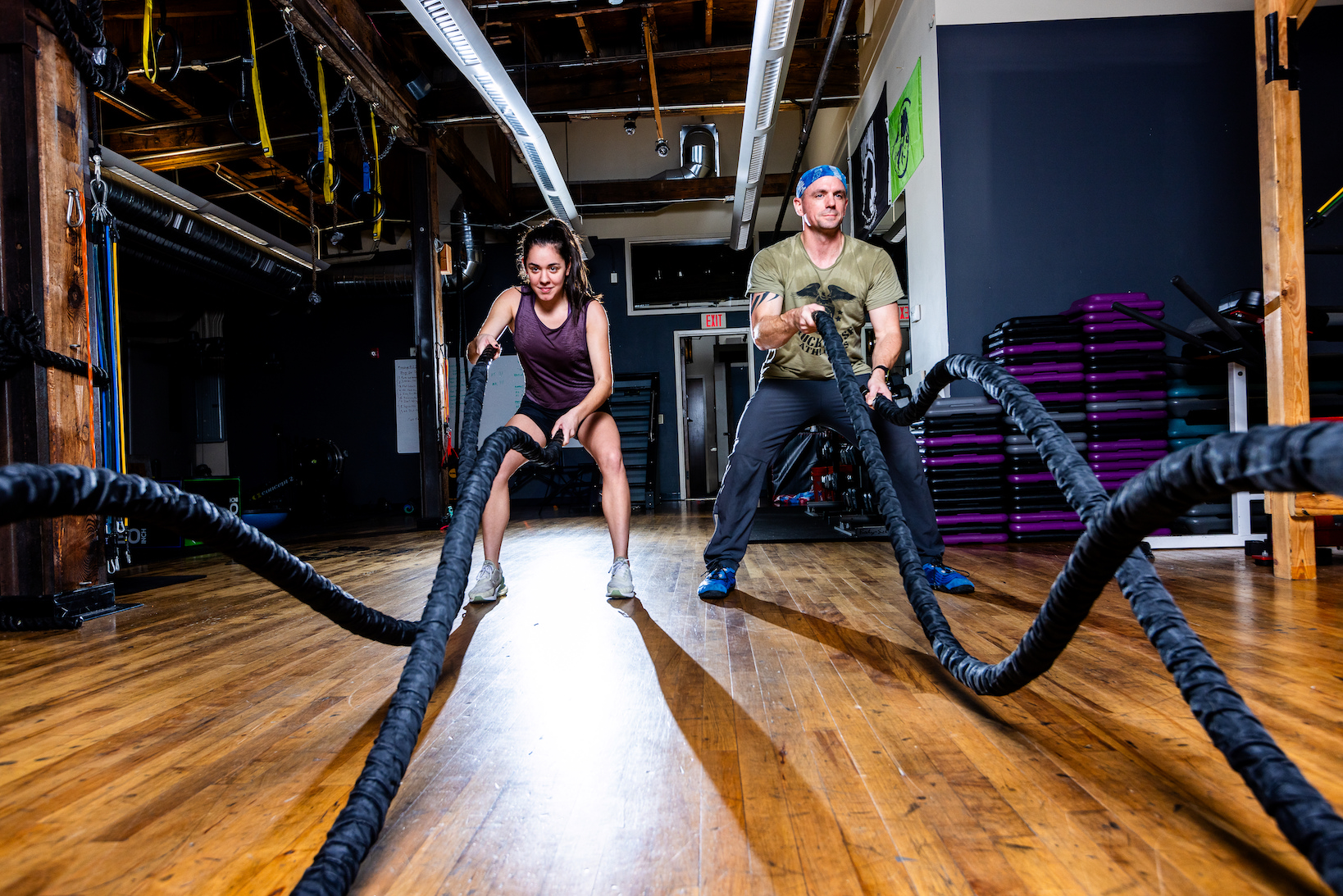
Ruckhouse Athletics. We coach the running, grip, carries, and obstacle skills together so your first start line is not your first attempt.
Free printable PDF
Get the Getting Started guide
Enter your email and we'll send you the designed PDF, the six-skill checklist, and the 8-week on-ramp you can print and follow.